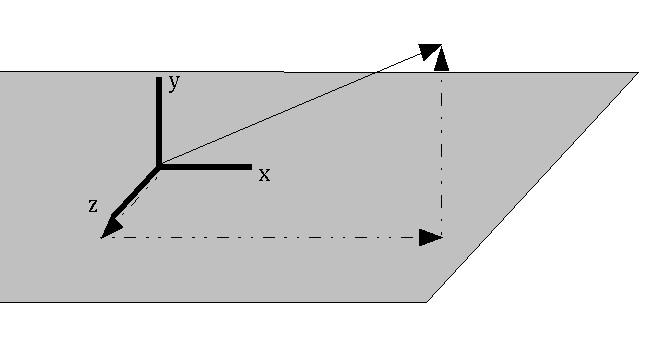
A vector is a direction and magnitude (length). Vectors are used to represent many different things - light source directions, surface orientations, relative distances between objects, etc.
We normally describe a vector as a triplet of (X, Y, Z) values - (vx, vy, vz) represents a vector that points vx units in the direction of the X axis, vy units in the direction of the Y axis, and vz units in the direction of the Z axis.
e.g., (2, 0, 0) is a vector pointing in the direction of the X axis, 2 units long. (1, 1, 0) is a vector pointing at a 45 degree angle between the X and Y axes, 1.414 units long.
The magnitude of a vector (x,y,z) is its "Euclidean" length - the square root of x2 + y2 + z2.
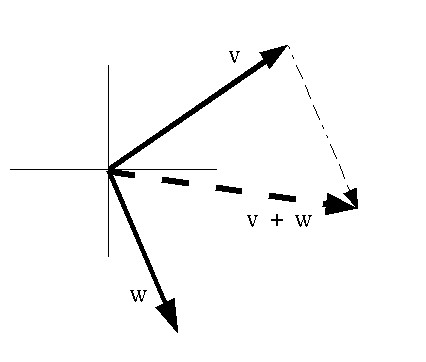
Two vectors can be combined by adding their corresponding components
together.
i.e. (vx, vy, vz) +
(wx, wy, wz) is
(vx+wx, vy+wy, vz+wz).
Or, written more expansively:
  | vx |     | wx |     | vx + wx |
  | vy |  +  | wy |  =  | vy + wy |
  | vz |     | wz |     | vz + wz |
The result is a vector that is equivalent to sticking the vector W onto the end of vector V, and creating a new vector from the beginning of V to the end of W.
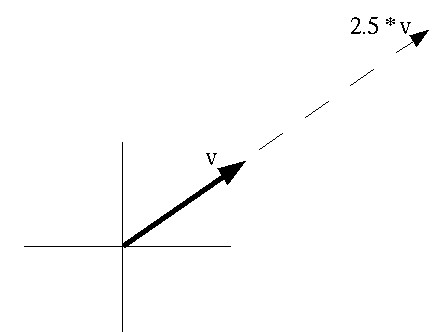
A vector can be multiplied by a single number (a "scalar") to change its length without changing its direction.
        | vx |     | s * vx |
  s  *  | vy |  =  | s * vy |
        | vz |     | s * vz |
The dot product of two vectors is an operation defined as:
  | x0 |   | x1 |
  | y0 | * | y1 |  =  x0*x1 + y0*y1 + z0*z1
  | z0 |   | z1 |
The result is a single number, which is equal to the product of the lengths of the two vectors and the cosine of the angle between them.
It can tell us how much two vectors point in the same direction - it is maximum when they point in exactly the same direction, and it's 0 when they're at right angles.